
Originally published on Work:Ethic. All photos property of the author.
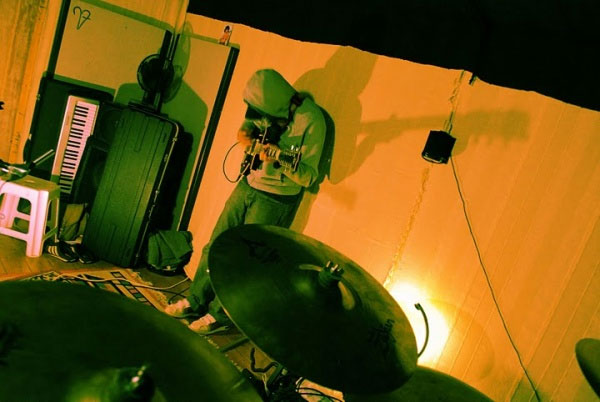
 Anyone who followed Ex Libras‘ exploits making “The Shed” on their [sadly, now defunct] blog, Guerilla Movements, must have been impressed by their determination. Using their 3 meagre salaries they’ve assembled a creative space they can use whenever they want at no extra cost. It’s there that I had agreed to meet them.
Making the long journey across London, I have another chance to listen to their debut album, Suite(s) and it strikes me just how well suited it is to commuting. As I walk through the hectic crowds then sit among the faceless passengers on the tube it reminds me of how lonely life in London can be surrounded by thousands of people. Ex Libras‘ blend of guitar/synth electronica somehow captures this perfectly. After listening, you’re left with a feeling of emptiness, but that’s no criticism. It’s like looking out over a desert plain as it disappears into the horizon. The album can be hard to dip into, but when taken in one sitting the experience can be quite euphoric, albeit tinged with a heavy dose of melancholy.
Ex Libras are Amit Sharma (guitar and vocals), Kieran Nagi (keyboards) and Ross Kenning (beat maker and bass guitar). Their live performances are something to behold. All 3 push the capabilities of their instruments to the limit of what can be achieved in a live setting, creating vast soundscapes with an array of samplers and drum sequencers. There are no pre-recorded loops: everything is sampled live on stage and then activated by triggers throughout the set. The crowd soon becomes completely submerged by Amit’s sweeping angelic vocals, while Ross and Kieran create an intricate backdrop of heavy beats and brooding synthesizer.
When I meet Ross, my guide for the evening, he asks, “You don’t have a problem wearing a blindfold on the way to the shed, do you? Only one other person has ever seen our studio”.
I laugh, but I’m not entirely sure whether he’s kidding or not.
So what prompted you to build your own recording space?
Amit: The death of Riot Club. It was a rehearsal studio in Hounslow run by a guy named Lee Farrow. The majority of the area’s bands passed through there at one point or another. It had been running for ten years, but we only got together in the last two months before it closed down, leaving us wondering how the hell we were going to rehearse – not in a desperate way, we were just tired of having to pack up our gear and hump it across town, paying £60 to £80 for four hours rehearsal. It was Kieran and Ross who came up with the idea.
Ross: Kieran suggested this shed that he knew about. We’d had a bit to drink and at the time it all seemed a bit improbable – the place was a state.
Kieran: The only other places we tried were a nightmare to get to due to the amount of equipment we used, so we took some time to persuade the owners and in the end the owners were quite happy to have a chance to get rid of all the crap that had built up in there over the years.
It must have been quite a job.
Ross: Initially when we had a look at the place it was almost like . . . when we knew how much had to be done – it took about six months in total, would you say?
Kieran: Six months on and off.
Ross: Yeah, on and off. We did most of the work on Sundays, weekday evenings, sometimes we were hungover but we just thought “get in there, do it”. Once it started it was like a snowball effect. I don’t think any of us would have put in that much money and time for something that wasn’t going to happen.
Kieran: We just threw ourselves in at the deep end. We didn’t know that much about building a studio, so at work all three of us would be looking up soundproofing instructions, tips on how to dissipate sound. Basically, this is a just wooden shed so it reverberates every single part of the wooden structure. We needed to find a way to build something inside, like an internal room.
Ross: Apart from the floor there’s a gap in between this room and the external walls, so it’s a room within a room. Everything’s hanging from these resilient bars, which separate the external from the internal structure. Using that theory we’ve managed to create some really good quality sound-proofing.
I’m quite impressed – you’re right in the flight path, and I could barely hear the plane that just flew over.
Kieran: The actual physical size of the shed is a lot bigger than what you can see now. There’s about 5 inches from each wall completely insulated.
Originally it belonged to a railway enthusiast who built the whole shed around his model railways, so there used to be boards and trains all over the place. It’s quite nice to carry on the shed’s use for something else – he was passionate about railways, we’re passionate about this so it’s nice to not just be using the place as a storage facility.
You’ve all been playing for quite a while, could you let me know about a couple of the projects you worked on before Ex Libras?
Kieran: Well, Amit was in Stasi, I was in King Mob and Ross was in Lesser Gods.
Ross: I’ve also played with Kieran before, a nine piece called People, mainly a funk/soul outfit, which was fun while it lasted. I think Amit’s only been in one band before.
Amit: Yeah, one band and solo spots under various guises. When I started playing guitar at 15 I used to play with a guy called Sam and we’d been playing together until Stasi split. I’m a one band man.
Kieran: We’ve all got mini projects that we work on: Ross does loads of production and engineering for other people and Amit’s got his solo stuff so it’s a nice culmination. All three of us bring different influences. All my bands have been funk and groove based, so I’ve had to adapt while playing with the other two. But I brought funk into the band. [laughs]
All three of you are quite independently creative, how does that affect the dynamic when you’re rehearsing? Who takes the lead when you’re writing?
Kieran: Well, no one really takes the lead. I mean, we’ll all come into the studio in some kind of state of mind and we’ll just start jamming, getting into a groove and when we’re more comfortable we’ll come up with different parts. Ross might come up with a drum part and we’ll lay something over the top, Amit will come up with a guitar part, we’ll lay some bass down, I’ll do some keyboard – it just happens like that. The things that we like, we work on. The good riffs become tunes just by constantly working on them.
Ross: Some songs have basically just been written in a twenty minute jam. Everything that we play in here gets recorded so we can always look back on it, and there’s never that feeling of “What was that? Will we be able to recreate it?” EVERYTHING is recorded and listened to. Things that we like, we pick out and work on. ‘Phat Knickers’ [track 3 on the album] was one of the first rehearsals . . .
Kieran: It was THE first rehearsal.
Ross: The body of that song came from about 20 mins of a 5 hour rehearsal. A guy I used to play with was really adamant about recording everything. His ideology was that it was a wasted rehearsal if it hadn’t been recorded. He was really jam orientated (god, I hate saying jam and jamming, but it’s the only real word I can use), he’d tape everything, go home and edit down the bits he liked, put some bass and guitar stuff over the top of it on a four track, maybe stick in some a capella from an old record and I’ve always kind of approached things in the same way since then. It takes the stress out, just not worrying about remembering, not getting it again, thinking “when was it great?”
So, at the risk of sounding like a prat, it’s all a fairly organic process?
Ross: Well, personally I’ve got a lot of confidence in the other two and once you have that it’s nice to let the walls down, lower your defences. Let everyone make enough mistakes in the early months so they feel comfortable in front of you when things go wrong. You have to go through these things to get to the good bits. It’s not about doing it first time. It will eventually come, if you give it enough time and no one’s judging you and you’re not judging anyone else.
Kieran: There aren’t ever many creative differences in the band. There’s never been a massive argument, none of that shit. We always give constructive feedback and we’re all willing to take it on board, so it’s a happy medium.
 Amit: It even gets to the point that one of us is playing something they don’t like, but the other two are like “no, no that’s really good”. We trust each other enough to say “shit, okay. I’ll play it”. [laughs] I didn’t like our track ‘Phat Knickers’ for the longest time, just didn’t get or understand it at all, but now it’s possibly one of my favourites, and it’s only because I trusted them two enough to let myself live with it that that’s happened.
Ross: A lot of it is about listening. There’s a lot of space on the album. There’s no crowding. It’s almost like a three way conversation. No one’s jumping on each other’s back trying to play the most. It’s almost what you choose not to play and letting other people take over, letting it breathe as one body.
Your album “Suite(s)” very much has its own sound. How hard is it translating what you do in the shed into a live performance?
Amit: That was the beauty of the record. The way we approached it is just a snapshot of us at the time. It doesn’t matter if it has mistakes on it, we’ll go in and record it live. At the very least it will make a good demo. But for all its flaws, it’s the mistakes that I like about it – it’s just of this time, just a live recording we’ve magicked into an album that people seem to like.
Ross: Like Amit says, we weren’t sure what it was going to be, it was like, “Do we do this now? Do we leave it a while? Do we use other recording techniques like going into a studio and laying down the drums first, then bass and guitar like most bands?” It used to be all about playing live – a lot of early records would just be a band in a room with one mic. What worked in our favour, which came out of building our own place, is that we all felt really comfortable in here; we knew exactly what we were doing. We’d rehearsed the songs so many times that all we really did was introduce 8 or 9 mics and played it live, like a rehearsal. Rather than capture a perfect take by overdubbing 16 guitar tracks it was more about energy. Each song was played, maybe, three or four times and that was it. We usually got it on the second or third take, but it was a real compromise between all 3 parts. I could do something great but maybe it wasn’t happening on the keys or I could do something great and it wasn’t happening with Amit. Or I was just really great and the other two just weren’t happening. The point I’m trying to make is that . . .
Kieran: He’s really great. [they all erupt, laughing]
Ross: . . . there were always going to be parts that some of us weren’t happy with, but we had to reach a general consensus of whether we’d captured the best energy. We had to strip down the ego and just listen to each track as a tune rather than its individual parts.
Kieran: It doesn’t matter if it’s technically brilliant or clinically perfect – personally I didn’t want that at all. If it fits when we listen back to it, then that’s the one, even if I made a mistake, it doesn’t matter. You look past the technical. You can always be a perfectionist and say, “Let’s do it again and put that part in”, but then you listen back and think “maybe I should change this part now”. It’s a slippery slope.
Ross: This was just 3 people trying to do the best they could with the money and time they had available. Right up until the release there was always this doubt that it could sound like a really cheap production. Would reviewers notice that? It was almost like someone looking at you naked and seeing all your faults.
Kieran: [smiling] What?
Ross: Like walking into a room with a technicolour dreamcoat. Sometimes you think too much about how reviewers . . .
Kieran: [about to crack] Seriously, what?
Ross: Let me finish. I thought, personally, far too much about how reviewers and people listen to music. When I listen to music, just because I’ve worked in recording in the past, it’s very easy to go right in there and dissect it. I was really surprised at the response the album got. We’re basically now on a level playing field with people who’ve spent thousands of pounds in a studio and still not got the same kind of energy we did and it really taught me a lesson. It’s all about capturing the performance more than anything else.
It’s interesting you say that, as I had no idea that the album was recorded live. When you listen to some albums made on the cheap the first thing to suffer is the subtlety of the instruments and the vocals, but with “Suite(s)” it’s very vocally driven, and each instrument gets a chance to speak for itself.
Ross: Well, all Amit’s vocals were recorded on SM58. Most people would be looking at maybe a thousand pound mic, minimum, to do vocals.
Kieran: It was also recorded on to a £300 Dell pc.
Ross: It’s kind of like a pinch yourself scenario.
Kieran: There’s no £20,000 pro tools rig – we did use pro tools to record it, but it’s on the cheapest computer we could buy.
Ross: Looking back now I do feel a bit guilty because I wish I’d had more confidence in the process. I always had niggles in the back of my head – is it going to be good enough? I’m absolutely astounded by the reviews.
How did it feel to have the album leaked?
Kieran: It felt good.
Ross: [smiling] It felt really good.
Amit: I mean, who gives a shit about us enough to put the album out before it was released?
Kieran: We read about things like that in the music press, and then suddenly “Ex Libras’ “Suite(s)” released on 99cent Russian download site.” It was weird.
Ross: I dunno, maybe a lot of things get leaked. The point was that it wasn’t just leaked – it was downloaded. There were comments on Russian websites from people who enjoyed it and wanted to know where it was coming from.
That was the most surprising thing. The only reason we found out was because it was on 20 or 30 different download sites all over the world. Even now, on Last FM, there are so many listeners from Russia, Ukraine, all the Baltic states, who we wouldn’t have reached otherwise.
Amit: Exactly. I think it’s a blessing in disguise. We’re not at the stage where we have to worry about money. We made it on a budget and the whole point was getting it out there to as many people as possible and somebody has done that for us for free.
Ross: As a marketing campaign, it’s great.
Kieran: Now most of the people who’ve bought the album through the website are from outside the UK. Japan, Greece, Ukraine, Germany – everywhere. It’s really nice because it’s got that far.
Is that what made you decide to tour Europe?
Ross: I think we’ve always wanted to tour Europe, just to get out of the UK, especially London.
Amit: It’s now a good reason to do a European tour, because we can justify going further into places where people have actually heard us. Whereas, before it was just “Get in a van, play here, sell CD’s, come back next year”, but half of that battle’s already been won because people are actually listening to the album.
Kieran: I just want a road trip. [laughs]
Ross: There’s very much a mentality over there where people go to gigs without necessarily knowing what bands are due to be playing. It’s different from London. It’s great being around really enthusiastic people and they’re more on the music side than the image side. The crowds a bit older and there’s a bit more passion. I do think there’s a bit more respect for British music over there, which is easy to forget when you’re in the middle of it.
So what are your plans for 2010?
Ross: We are playing a small European tour with our good friends Gin Panic in February and then a North England/Scotland tour in April. We’re then planning on recording the next album later on in the year, so keep your eyes peeled.
Kieran: Who knows, it might get leaked!