
Originally published on Panic Dots.
 I’ll never forget the first time I saw π, Aronofsky‘s brilliant debut. A friend of mine sat me down, told me to shut up, watch, and listen, then switched the movie on without another word. It was the most intense audio-visual experience I’d ever had, and I desperately wished I could go back in time to experience it all over again, fresh, with no preconceptions.
Aronofsky has since then added to his impressive body of work – some well received, others not so much (I don’t care what you think, I thought The Fountain was a great film). All of them, without exception, feature a protagonist consumed by an internal quest: in π it’s Max‘s (Sean Gullette) search for the perfect number system, Requiem For A Dream sees Harry (Jared Leto) lose himself in the pursuit of heroin, The Fountain has Tom (Hugh Jackman) desperately trying to develop a cure for his wife’s terminal brain tumour and The Wrestler, by far Aronofsky‘s most intimate and naturalistic creation, shows Randy (Mickey Rourke) trying to piece his life together after a heart attack forces him to retire from professional wrestling.
Black Swan is no different. Nina (Natalie Portman) is a professional Ballet Dancer given the opportunity to dance the lead in her company’s production of Swan Lake. Her choreographer Thomas (Vincent Cassell), has chosen her for the part, despite his concerns that, while she’s a technically brilliant dancer, she lacks the ability to truly lose herself in the role. The lead in Swan Lake is particularly challenging, as the dancer has to convey the graceful, innocent beauty of the white swan, as well as the dark and brooding sexually charged mystique of the black swan (the white swan’s evil twin sister).
Nina‘s fundamental character flaw is her need for perfection, both on and off stage. She rehearses obsessively, every move she makes has been practiced to the point that she’s no longer having to think while dancing, and this proves to be a stumbling block when rehearsing for her new role. While it’s an acceptable approach to the white swan, the black swan requires more of an emotional commitment, a mental abandonment that her choreographer initially feels is beyond her capability.
When Lily (Mila Kunis) appears on the scene (on loan from a San Francisco ballet company) Nina‘s world starts to slowly crumble around her. While Lily isn’t as technically brilliant a dancer as Nina, she’s able to infuse her movements with a passion and sexuality that Nina is unable to reproduce, and this new dancer is a potential threat to her newly appointed role.
Nina‘s entire life is dancing. We see nothing of her social life; in fact it’s made clear that the only social interaction she encounters when not at the dance studio is from her overbearing mother (Barbara Hershey), and this goes a long way to explaining why she finds it so hard to convey passion and smouldering sexuality: she lacks the life experience necessary to draw from, and it’s not something that can be learnt. Nina‘s mother seems to have locked her in a perpetual state of innocence, where appearance is everything, and her daughter must succeed to appease her own failed dance career. The audience gets the distinct impression that as demanding as ballet dancing is, it’s the only real thing that Nina can escape to, to avoid her overbearing mother. The real tragedy is that by denying her daughter a life outside of dance, she’s denied her the opportunity to develop emotionally, thus stunting her dancing ability.
At first glance it would seem that Black Swan is the spiritual sequel to π. Like Max‘s all consuming passion for his number system, Nina‘s obsession with the role of the black and white swan (and dancing in general), drives her to push herself far beyond the realms of normal behaviour, and causes her a significant amount of mental distress. This is conveyed expertly in the film’s cinematography. The physically demanding world of ballet is renowned for its obsession with beauty, and you would be hard pushed to find a shot in this film that doesn’t have a mirror or reflection featured in it. It’s also a clever device for displaying the duality of Nina‘s character and of the white and black swan. While it’s tempting to write more about this aspect of the film, to do so would truly ruin the experience for those who haven’t seen it, and there’s enough material to write a thesis.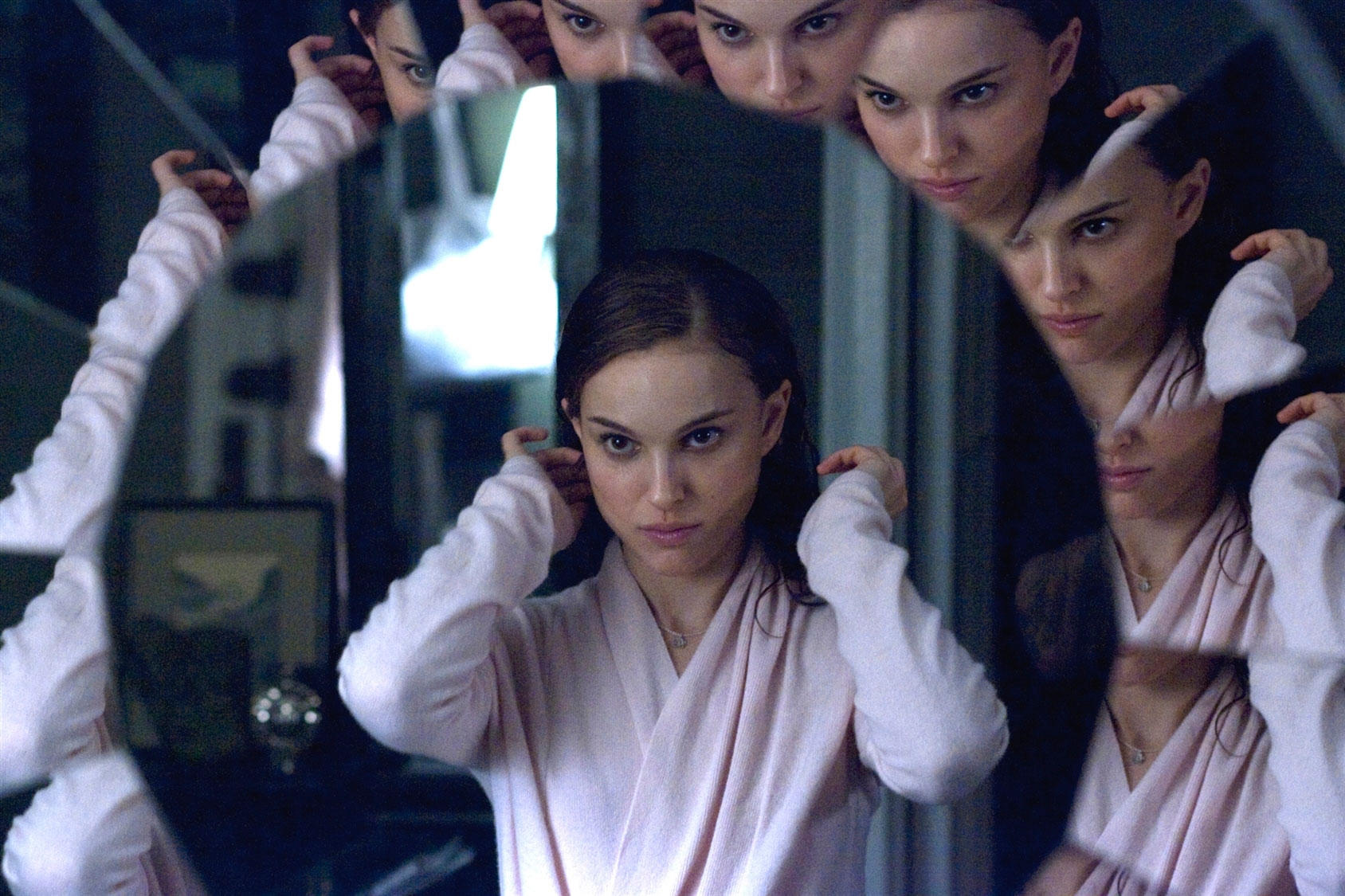
Ultimately, Black Swan, and indeed, all of Aronofsky‘s films, tell the story of someone who’s struggling to escape from a reality that’s slowly, and painfully, consuming them – whether it’s escape through drug use, throwing yourself into your work to avoid facing up to your wife’s impending death, or becoming a wrestling superstar on weekends so you can forget that your daughter hates your guts and you live in a trailer park.
Black Swan is no different.
Now, to the dancing. It’s a guilty secret of mine that I studied dance for a short period of time, but even so – ballet tends to leave me feeling a little cold. I was initially concerned that despite Aronofsky‘s involvement in this film, I’d find the dance sequences a tad boring. It’s always best to strip yourself of pre-conceptions before a film, but if I was having to review a film about football (a sport I’m so indifferent about I can’t even bring myself to rant about it), I’m almost positive that shots of play would greatly affect my enjoyment of the film. I had no such problem’s with Black Swan. All of the dance sequences are nothing short of beautiful, Portman and Kunis have obviously trained to a professional standard before shooting, and there were points in the film where the choreography and music were so powerful, I was practically reduced to tears. While I’m not going to rush out and buy tickets to the next ballet I see advertised, if they were for the production of Swan Lake that’s being performed in the film, I’d not only buy tickets, I’d probably go more than once.
Black Swan is an impressive psychological thriller from a master director who never fails to disappoint.