
Originally published on Panic Dots.
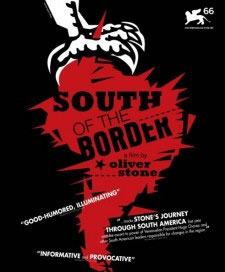 It could be said that Oliver Stone’s movies have gone off the rails in recent years (I stopped watching after U-Turn), but there’s still some light at the end of the tunnel when it comes to his documentaries. If you haven’t seen Commandante, the 2003 documentary Stone filmed around his visit to Cuba and the notorious interview with Fidel Castro, do it now.
Stone’s follow up, South of The Border, focuses mainly on Hugo Chavez and his rise to power within Venezuela. It’s also a damning critique of the US media and its relationship with foreign policy; from 9/11, the Iraq invasion and its failure to locate WMDs, and its insistence on portraying South America’s democratically elected leaders as dictators.
It’s an impressively in-depth account, with excellent use of archive footage sourced from various news networks. Stone even goes so far as to deconstruct a piece of propaganda shown on US news networks, depicting Chavez supporters firing upon anti-Chavez demonstrators – it turns out the footage is an amalgamation of three pieces of film, which originally showed both factions being fired upon by gunmen on top of an apartment block (JFK anyone?).
Chavez’s refusal to become a lap-dog for the Oil Industry, the IMF and, essentially, the USA, has garnered a lot of support within Latin America. After concentrating the first half of the documentary on Chavez and Venezuela, Stone turns his camera towards other countries in South America that have joined Chavez on a quest to become recognised as relevant players within world politics.
 While South of The Border is, by Stone’s own admission, a little one-sided, and at times it can be unclear whether Stone or Chavez is leading the documentary, it still needed to be made. It charts the emergence of a New South American order, akin to a Latin European Union, where the US has been forced to deal with all of the member countries as equals – including Cuba. This is a huge step for South America, and it’s a testimony to Oliver Stone’s passion for free speech, that he’s risked his reputation to show the other side of the story. He’s continued his attack on US foreign policy, and allowed himself to become the temporary mouthpiece for a collection of countries that receive, almost without exception, nothing but negative press in the Western Media.